
K9 sniff searches are a routine part of law enforcement across the United States. Police departments rely on trained detection dogs to help locate drugs, explosives, and other contraband during traffic stops, building sweeps, and border crossings. On the surface, these searches can seem straightforward—but the reality is far more complex.
For citizens, defendants, and anyone who values their constitutional rights, knowing what K9 searches can and cannot do matters. The gap between what most people believe about police dogs and what the science and law actually say can make a significant difference in a criminal case. This post breaks down three of the most pervasive myths—and the facts that counter them.
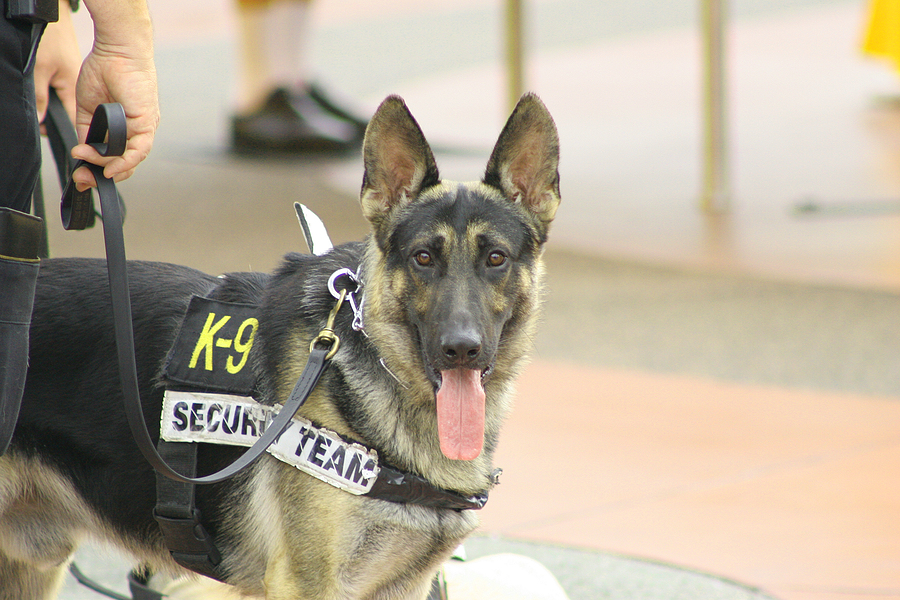
Myth #1: Police Dogs Can Detect Any Substance
Many people assume that if a K9 unit shows up, the dog can sniff out just about anything. It’s an understandable assumption—but it’s not accurate.
The Reality of Canine Olfactory Limitations
Detection dogs are trained to alert to a specific set of scents, typically a handful of controlled substances or explosives. A dog trained to detect marijuana and methamphetamine, for example, will not necessarily alert to prescription opioids or chemical weapons components. Each dog’s training profile is narrow by design.
Beyond the scope of their training, false positives are a real and documented problem. Handler behavior plays a direct role here. Dogs are highly attuned to their handlers’ psychological cues and are strongly motivated to please. A handler who expects a dog to find something may—consciously or not—send subtle signals that prompt an alert. This was demonstrated clearly in United States v. Bentley, where a dog alerted 93% of the time it was called out, yet only 59.5% of those alerts were accurate, resulting in a false positive rate of 40.5%. Critically, the handler in that case rewarded the dog for every alert, regardless of whether drugs were actually found.
Training limitations and handler influence mean that no K9 team is infallible.
Fact #1: K9s Have a Remarkable Sense of Smell
That said, the canine nose is genuinely extraordinary—and it’s worth appreciating just how powerful it is.
The Science Behind Canine Scent Detection
Dogs possess between 125 and 300 million olfactory receptors, according to research published in PubMed Central. Humans, by comparison, have approximately 5 to 6 million. Dogs also smell in three dimensions—each nostril operates independently, allowing them to determine the direction a scent is coming from and build a detailed picture of their surroundings.
Properly trained K9s can detect trace amounts of substances even when smugglers go to great lengths to conceal them—vacuum-sealing packages, coating them in motor oil or detergent, and hiding them inside gas tanks. Law enforcement professionals who have witnessed this firsthand describe it as remarkable.
The key distinction is this: dogs have the ability to detect scents at incredibly low concentrations, but ability alone doesn’t guarantee accurate performance in every situation. Reliability depends on training quality, handler expertise, environmental conditions, and the dog’s individual record over time.
Myth #2: K9 Searches Always Require a Warrant
A common misconception is that police need a warrant to conduct a K9 sniff search. In many situations, they do not.
Legal Standards for K9 Sniff Searches
The legal landscape around K9 searches has been shaped by a series of landmark Supreme Court rulings.
In Illinois v. Caballes (2005), the Supreme Court ruled that conducting a dog sniff around a vehicle during a lawful traffic stop does not violate the Fourth Amendment. Because the sniff occurs in a public space, it is not legally considered a “search”—meaning no probable cause or warrant is required.
However, the Court has drawn firm lines. In Florida v. Jardines (2013), the Court ruled that bringing a drug-sniffing dog onto the porch of a home without a warrant is unconstitutional. The curtilage of a home—the area immediately surrounding it—receives strong Fourth Amendment protection.
Then came Rodriguez v. United States (2015), where the Court ruled 6-3 that law enforcement cannot extend a traffic stop beyond its natural conclusion simply to wait for a K9 unit to arrive. Once the reason for the stop is resolved, continued detainment without additional probable cause is a Fourth Amendment violation.
The takeaway: K9 searches in public spaces operate within a specific legal framework that does not always require a warrant—but that framework has clear limits.
Fact #2: Handler Training Directly Affects Search Accuracy
The performance of a K9 team depends heavily on the training and accountability of the handler—not just the dog.
The Importance of Professional K9 Training and Oversight
Law enforcement agencies that use K9 units are expected to ensure their handlers complete certified training programs. Organizations like the American Police Canine Association (APCA) set certification standards for police K9 teams, covering scent detection proficiency, obedience, and courtroom testimony preparation.
In Florida v. Harris (2013), the Supreme Court ruled that a dog’s satisfactory performance in a certified training program is generally sufficient to establish probable cause from an alert. Courts are not required to demand detailed statistical performance histories.
This ruling has real consequences. Without a requirement to track and disclose field performance data, some departments have little incentive to monitor false positive rates. As was documented in Bentley, a handler who keeps records only when an alert leads to an arrest can present a misleading picture of a dog’s accuracy.
For anyone facing charges based on a K9 alert, pursuing discovery on the dog’s full performance record—including negative outcomes—can be a legitimate and valuable defense strategy.
Myth #3: A Positive Alert Always Means Drugs or Contraband Were Present
A K9 alert is often treated as near-certain proof that contraband exists. It isn’t.
Why False Positives Happen More Than You Might Expect
Dogs alert to scent, not to the physical presence of a substance. This means a vehicle that previously transported drugs—or that has handled drug money, which can carry trace narcotic residue—may trigger an alert even if no contraband is present at the time of the stop. Environmental cross-contamination is a real and scientifically documented phenomenon.
Beyond residual odors, psychological cuing from handlers remains a documented source of inaccurate alerts. The Bentley case made this plain: when a dog is rewarded for every alert regardless of accuracy, the dog learns to alert often—not accurately.
Courts are becoming more willing to scrutinize K9 evidence. While Florida v. Harris raised the bar for defendants who want to challenge K9 reliability, it did not close the door entirely. Defense attorneys can still introduce performance data and challenge the conditions under which a search was conducted.
An alert is the beginning of a legal inquiry—not the end of it.
Frequently Asked Questions About K9 Sniff Searches
Can K9 search results be challenged in court?
Yes. After Florida v. Harris, courts generally accept certification records as sufficient for probable cause, but defendants can still introduce evidence of a dog’s field performance history, handler conduct, and the conditions surrounding the search. A skilled criminal defense attorney can identify weaknesses in K9 evidence.
How often are K9s retrained and recertified?
Certification requirements vary by state and agency. Most professional certifying bodies, including the American Police Canine Association, require annual recertification. However, there is no single federal standard that applies uniformly across all jurisdictions.
What should I do if I believe a K9 search was unlawful or produced a false positive?
Do not try to handle it on your own. Document everything you remember about the stop—the timeline, what was said, and how the dog behaved. Then consult a criminal defense attorney as quickly as possible. Evidence gathered through an unlawful search may be suppressed, and inaccuracies in a dog’s record may support a legal challenge.
Does a K9 alert give police the right to search my home?
No. A dog sniff at the door of your home—or on its porch—requires a warrant. The Supreme Court’s ruling in Florida v. Jardines established that bringing a K9 onto the curtilage of a home without a warrant is an unconstitutional search.
Know Your Rights—Then Act on Them
K9 searches are powerful tools, but they are not perfect, and they are not without legal limits. False positives happen. Handler bias is real. And the law draws clear lines about when and where police can deploy a drug-sniffing dog.
If you’ve been arrested or charged following a K9 search in Indiana and believe your rights may have been violated, don’t wait. Attorney David E. Lewis is an experienced Indianapolis criminal defense lawyer who understands the nuances of search and seizure law. Contact his office today to schedule a free case consultation and get the legal guidance you deserve.
Related Posts:
Your Rights Against Unreasonable Searches
Do I Have to Consent to a K9 Sniff Search?
Do I Have to Let Police in My House if They Show Up With a Search Warrant?