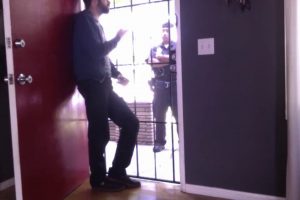
Do I Have to Answer My Door if it’s the Police?

Indiana Criminal Defense Attorney 317-636-7514

Indiana Criminal Defense Attorney 317-636-7514

One of the most common questions received by criminal defense attorneys is, “Am I legally obligated to answer my door if it’s the police?” And it is actually a very good question. Answering the door doesn’t usually cause any sort of alarm for someone, but when it’s the cops knocking, many residents get paranoid. They are concerned that police have the legal right to barge into their home and begin searching for incriminating evidence against them if they open their door. They wonder whether or not opening their door to police allows officers to come inside without permission.

Unfortunately, the answer to these queries are not so cut and dry, but it is easy to understand. Continue reading to learn your rights to such privacy in Indiana, and what to do if you are confronted by law enforcement at your place of residence.

The Fourth Amendment

Every United States citizen has the right to a certain degree of privacy, as alluded to in our country’s constitution under the 4th Amendment, which reads “The right of the people to be secure in their persons, houses, papers, and effects, [a] against unreasonable searches and seizures, shall not be violated, and no Warrants shall issue, but upon probable cause, supported by Oath or affirmation, and particularly describing the place to be searched, and the persons or things to be seized.SOURCE

The Right to Decline

Indiana Criminal Defense  317-636-7514

Indiana Criminal Defense 317-636-7514

Citizens, in most cases, have the right to legally decline to open the door for law enforcement, as well as, terminate their opportunity for entry (i.e. shut the door after answering it to prevent further communication). However, there are always exceptions to every rule. If law enforcement retains the proper documents, such as search or arrest warrants, they can enter a person’s home, even without permission.

The circumstances vary from case to case, which is why it is imperative to discuss your legal concerns with an experienced Indianapolis criminal defense lawyer. They have the knowledge, skills, and local resources to provide accurate answers and professional counsel you can trust.

How to React to Law Enforcement at Your Door

The best way to deal with law enforcement at your door is to simply answer it. If you are not aware of any crimes or charges against you, there should be nothing to worry about. Most often, if you are not suspected of a crime, police are simply in need of some neighborhood information, such as a missing person’s case, abandoned vehicles, and vacated apartment units. Otherwise, the police may believe you could be a witness to another person’s crime, and they need your help. If they do not have a warrant for your arrest, or to search your premises, you can shut the door and terminate your conversation at any time without legal recourse. As soon as the interaction is over, contact your defense attorney for further instructions. The police could be on their way back to the station to secure a warrant in some cases.

Indianapolis Criminal Defense

Criminal Defense Lawyer Indianapolis IN

Criminal Defense Lawyer 317-636-7514

Call Attorney David E. Lewis at 317-636-7514 for Indianapolis criminal defense you can trust. Our law firm offers free initial consultations to freely discuss the charges against you and the best strategies for defense. We will work around the clock to protect your rights and to preserve your freedoms. Call 317-636-7514 to get started today.

What are Pirtle Rights?

You’ve probably heard of the common American criminal jurisprudence called the Miranda Rights. These are the rights given to criminal suspects to protect them from incriminating themselves further. You can learn more about your Miranda rights by reviewing the fifth and sixth amendments of the United States Bill of Rights. They read as follows:

5th AMENDMENT – Protects the right to due process. Prohibits self-incrimination and double jeopardy.

6th AMENDMENT – Guarantees the right to an attorney. Protects the right to a fair and speedy trial, the right to be notified of accusations, the right to confront the accuser, and the right to obtain witnesses.

Review our blogs about “Understanding Your Miranda Rights” for a closer look behind the meaning of these amendments and their origins.

But aside from criminal suspect rights prior to an arrest, there’s another set of rights that exist to protect suspected criminals from impeaching searches and seizures. This is called the Pirtle Rights. Continue reading to learn more.

Indianapolis Criminal Defense 317-636-7514

Indianapolis Criminal Defense 317-636-7514

Your Pirtle Rights

The Miranda Rights primarily apply to interrogations, but your Pirtle rights apply to law enforcement seeking consent to search your property, whether vehicle, home, storage unit, or business. If a person is in police custody and asked to consent to a search of their property, they have the right to consult with their attorney and have them present before giving consent.

However, there are exceptions to this rule. If a police officer has reasonable belief that a person’s vehicle or property contains evidence related to the stop or arrest. For example, if a person is pulled over for speeding and the officer smells marijuana emitting from the person’s vehicle, the officer would be legally permitted to carry out a search of the vehicle since they have a reason to believe there may be drugs present.

It is important to discuss your personal rights with an experienced criminal defense attorney before choosing to invoke them during any future run-ins with law enforcement. Because there are some exceptions to the rule of your Pirtle rights, it is important to understand when it is appropriate to invoke them and when it is not. A trusted Indianapolis defense lawyer can provide you accurate and up-to-date information regarding all of your rights as a suspected criminal in Indiana.

Indianapolis Defense Attorney

David E. Lewis Attorney at Law

David E. Lewis Attorney at Law 317-636-7514

Call David E. Lewis, Attorney at Law, at 317-636-7514 if you are facing criminal charges in Indiana. Our law firm works around the clock, using every resource at our power to secure the best possible outcome for our client’s cases. Our top priority is to protect your rights and preserve your freedoms as a criminal suspect in Indiana. We offer free initial consultations to discuss your criminal charges and the best strategies for defense.

Can Parents Be Held Liable for their Kids’ Crimes?

Indianapolis Criminal Defense 317-636-7514

Indianapolis Criminal Defense 317-636-7514

Many parents view their own kid’s bad behavior as a way of them letting off steam, or even the result of them being thrown into socially and emotionally-charged environments or situations (i.e. school, divorce, death in the family, relocating, health conditions, etc.). But sometimes, a child’s actions cross the line from “typical” to criminal. So what happens when a child goes too far and knowingly commits a crime? Are the parents ultimately responsible for the damages caused by their child’s actions? Could the crimes of their children been prevented with timely parental intervention or supervision? Continue reading to learn the answers to these questions and more.

Up to 18 Years of Age

For children up to 18 years of age, parents can absolutely be held liable for any negligent, intentional, or criminal acts carried out by them. This is colloquially referred to as “parental liability” and falls into two categories: Civil parental responsibility and criminal parental responsibility. For the sake of this blog, we will take a closer look at criminal parental responsibility.

Civil liability would encompass property damages, personal injuries, slander, and other types of civil wrongdoings. It is possible for a person to commit a civil wrong-doing and a crime in one isolated act, such as putting lit fireworks in a mailbox. Not only is the mailbox destroyed and compensation can be recover for that loss, but blowing up a mailbox is also vandalism, which is illegal.

Criminal Parental Responsibility

Criminal parental liability holds parents criminally responsible for any crimes committed by their underage children, including allowing them access to a firearm and internet crimes. The laws surrounding criminal parental liability laws varies from state to state so it is important to discuss your city’s regulations on child/parent liability with a criminal attorney. Parents can be charged and sentenced, as well as, forced to pay restitution for property damages and compensation for injuries.

Indiana Criminal Defense

David E. Lewis Attorney at Law

David E. Lewis Attorney at Law 317-636-7514

Call David E. Lewis, Attorney at Law, at 317-636-7514 to discuss your recent criminal charges in Indianapolis, Indiana. Our law firm offers free initial consultations for those charged with a misdemeanor or felony crime, including minors. We work around the clock to build a strong and impactful defense against your criminal allegations. Call 317-636-7514 to speak with a licensed criminal defense attorney in Indianapolis you can trust.

FAQS Regarding Indiana Handgun Appeals

Indianapolis Criminal Defense 317-636-7514

Indianapolis Criminal Defense 317-636-7514

Were you recently denied a permit to carry a concealed weapon in Indiana? If so, you probably have a lot of questions. Below you will find a list of the most frequently asked questions about Indiana handgun appeals and procedures.

Review each question for a better understanding of what to expect during your petition process. Talk to a trusted criminal defense attorney for help with your handgun permit appeal.

Do I Need a Lawyer to Appeal?

You are free to represent yourself when appealing a concealed carry permit denial. However, the law and legal process is often tricky. It takes acute knowledge and experience to know how to carefully navigate a handgun permit appeal. For this reason, it is best to hire a criminal defense lawyer for help filing your petition.

How Long Do I Have to Appeal My Permit Denial?

In Indiana, you have 60 days to file for an appeal if you are denied a concealed carry permit. Within this 60-day period, you must fill out and submit all the necessary documentation and paperwork, as well as, pay the fee required by the courts.

Can I Re-Apply If I Miss My 60-Day Window?

Yes, you can re-apply your appeal if you miss the initial 60-day time frame. Simply re-apply and pay the courts. If you previously paid a filing fee, the money will be refunded to you.

How Long Does the Process Take?

The amount of time it takes to complete the appeals process all depends on the complexity of the case. For easy appeals, an experienced criminal attorney can usually secure a permit within 60 to 90 days, sometimes sooner! However, for moderate to complex cases, it could takes several months and even up to a full year to complete.

What Do I Do if I Was Denied Because of a Mental Health Issue?

Unfortunately, these are often the most challenging cases to appeal. With all the recent cases of mass shooting, and the history of violent crime, law enforcement and governments are hesitant to grant carry permits to those officially diagnosed with a mental health disorder. Talk to a criminal attorney to discuss your options.

Are Federal and State Standards for Handgun Permits Different?

Yes; the standards for granting concealed carry handgun permits differ between state and federal levels. This means you might be approved for a state-level permit, but not approved for a federal level one.

Why Was I Denied a Permit After My Old One Expired?

A new software program is now used that retrospectively evaluates existing permit holders’ eligibility. Some permit holders are denied permit renewal or lifetime permits because of new evidence found on their permanent record.

Indianapolis Criminal Defense

David E. Lewis Attorney at Law

David E. Lewis Attorney at Law 317-636-7514

Call David E. Lewis, Attorney at Law, at 317-636-7514 for help appealing a concealed carry permit denial in Indiana. Based out of Indianapolis, his criminal defense law office is conveniently located and open Monday through Friday by appointment. We offer free initial consultations to discuss your criminal defense needs. Call 317-636-7514 to schedule your appointment with a licensed Indianapolis criminal defense lawyer you can trust.

What is a Commuted Sentence?

Indiana Criminal Defense Attorney 317-636-7514

Indiana Criminal Defense Attorney 317-636-7514

To understand what a commuted sentence is and how it’s applies to criminal law, you need to understand the definition of clemency. Clemency is a type of non-judicial remedy used to reduce prison or criminal sentences, as well as, prevent errors of justice. In most cases, it is used as a last resort for prisoners who have exhausted all of their options for appeal. Essentially, it takes the place of the original court-ordered sentence.

One of the most well-known forms of clemency is called a pardon, however other examples include amnesty, reprieves, and commuted sentences. “Commutation of sentence” is another rare form of clemency that reduces a prisoner’s punishment for a crime. Most often, a commuted sentence is applied as a reduced prison term.

Commutation of Sentence

Only the President of the United States has the power to commute federal sentences, however, in many states the governor can commute a sentence. Neither legislative nor judicial branches can interfere or override the commutation of a sentence. Since commutation of sentence is a type of pardoning power, it is often assumed that a commuted sentences the same thing as a criminal pardon. But there are actually many differences between the two types of reduced criminal sentencing.

Pardons vs. Commuted Sentences:

⚖ Pardons forgive a defendant for their crime. Commutations merely reduce the punishment for a crime.

⚖ Pardons must be accepted by defendants. Some states do not require a defendant’s consent to commute their sentence.

⚖ Pardons restore a defendant’s civil rights that were lost upon criminal conviction. A commuted sentence does not.

⚖ Pardons are handed down for various other reasons, generally political. Commuted sentences are generally earned for good behavior.

The limits and applications to commuted sentences vary among states. For instance, some states do require defendants to consent to or accept a commuted sentence. Also, in many states, the government cannot revoke a commutation of sentence unless it was somehow attained fraudulently or by clerical error. And in almost all states, a commutation of sentence is granted on a conditional basis, meaning it comes with mandatory conditions that defendants must abide by.

Since the laws and procedures for commuted sentences vary among states, it is important to get proficient legal representation to learn your rights to a reduced criminal sentence. You need an Indianapolis criminal defense attorney with extensive trial and litigation experience. Choose attorney David E. Lewis for aggressive and skilled criminal defense in Indiana.

Indianapolis Criminal Defense

Criminal Defense Lawyer Indianapolis Indiana

Criminal Defense Lawyer 317-636-7514

Call David E. Lewis, attorney-at-law, at 317-636-7514 for skilled Indianapolis criminal defense representation. He offers free initial consultations so that you may discuss your criminal case with a knowledgeable and experienced criminal defense lawyer you can trust. Call 317-636-7514 to schedule an appointment with a criminal defense lawyer in Indianapolis, Indiana today.

Can You Get in Trouble for Ignoring a Subpoena?

Criminal Defense Attorney 317-636-7514

Criminal Defense Attorney 317-636-7514

A subpoena is a legal document that legally requests a person to provide information, testimony, and/or evidence to the court regarding a criminal or civil matter. There are two types of subpoenas, one that requires your appearance in court to provide testimony, and another that simply requires you to provide records, physical evidence, or documents to the court. They are serious legal documents that require some serious attention. Continue reading to learn more about subpoenas, and what happens if you
fail to respond to one.

Court-Ordered Subpoenas

Although most commonly used for civil cases, such as divorces, accidents, and custody disputes, subpoenas are also used for criminal cases. They are used by both the prosecution and the defense to gather evidence and build a case. If the law believes that a person has information that can help prove or defend a criminal case, the courts can issue a subpoena to legally order that person to provide the information they need.

Example 1: Brenda is a cocktail waitress at the local sports bar. She witnesses a bar fight that results in serious injuries to one of the regular patrons. The regular patron files an injury lawsuit against the other participant in the fight. Later, she is served with a subpoena mandating her to provide testimony in court regarding her narrative of the incident.

Example 2: Archie is Brenda’s employer at the bar she works at. She is getting a divorce, so he is subpoenaed by the court to provide her employment and paycheck records.

Managing a Subpoena

If you are served with a subpoena, never ignore it. Failing to respond to a subpoena on time can result in serious legal consequences, including hefty fines, criminal charges, and imprisonment. If you are being represented by a lawyer, and you are served with or issuing a subpoena, your lawyer will generally handle all of the associated needs. If you are representing yourself, you can request a blank subpoena document signed by the court clerk and fill it out there.

Subpoenas must be served in-person or by registered mail. Neither yourself nor lawyers can deliver or issue subpoenas. Lawyers will appoint a process server to deliver the subpoena to the recipient since it is not allowed to have anyone involved with the case handle this part of the process. If they are not properly delivered, they cannot be enforced by law.

Indianapolis Criminal Attorney

Criminal Defense Lawyer Indianapolis Indiana

Criminal Defense Lawyer 317-636-7514

Call David E. Lewis, Attorney at Law, at 317-636-7514 if you were served a subpoena in Indianapolis, Indiana. He is an experienced and aggressive criminal defense lawyer that is eager to help you with your legal matters. He offers free initial consultations and even provides criminal record expungement services for those looking to seal their criminal history. Call 317-636-7514 to schedule your consultation with a trusted Indianapolis criminal attorney, today.

Examples of Unlawful Search and Seizures

Indianapolis Criminal Defense 317-636-7514

Indianapolis Criminal Defense 317-636-7514

The Fourth Amendment of the United States Constitution gives citizens the right to be free of unlawful or unreasonable searches and seizures by law enforcement officials. In fact, this very search and seizure law is one of the trademarks of our country’s criminal justice system. It means that police and other forms of law enforcement must have a good reason to legally search a person or their property, as well as, seize personal belongings or make an arrest.

“Good reason” is established when police identify tangible evidence or facts that leads them to believe a person is committing, has committed, or intends to commit a crime. This is also referred to as probable cause. If sufficient probable cause is present during a police encounter in a place where privacy is not expected, a search and seizure is not deemed unreasonable, therefore, it is not illegal. Places where privacy is not expected include anything that is in plain view or public, such as the front seat of a car, disposed garbage, and public places.

Places where privacy is expected: private residence, hotel room, trunks of cars, luggage, and even a closed telephone booth. To help understand what is legal and what’s not, continue reading for some examples of unlawful search and seizures.

Traffic Violation Stop

Janet is pulled over for speeding. The officer learns that her license and suspended and she does not have auto insurance coverage for the vehicle. For this reason, he must have the car impounded. During a legal vehicle impound, an officer is allowed to conduct an inventory search of the contents of the vehicle. But the search must be conducted according to standard police regulations and procedures. The officer asks Janet to step out of her vehicle and stand in front of his squad car.

She exits her vehicle, taking her purse with her, and follows his orders. As she is standing in front of the police car holding her purse, the cop instructs her to place her purse in the trunk of her car instead. Now that the purse is in her vehicle, the police officer uses the opportunity to search the contents of her purse as part of the inventory search. As a result, he finds a small amount of marijuana in her purse, and then he arrests her on drug possession charges.

Later, the court finds that: 1) the search did not comply with the standard regulations for an inventory search, 2) the defendant had her purse outside of the vehicle when the officer instructed her to place it back inside, and 3) there was no evidence of criminal traffic violation, only standard traffic infractions. Since the courts ruled that the search was unlawful, the evidence found during the search was dismissed. And although the impounding and inventory search were legal, the search of her purse was not. So in the end, Janet was not charged with drug possession.

Noise Disturbance Call

Amy is fighting with her live-in boyfriend Dan. Neighbors call the police to report the noise. By the time the police arrive, Amy and Dan have calmed down and reconciled. They consent to letting the police inside their living room to discuss the calls from neighbors and to confirm that there isn’t a problem. The responding officers so not see anything illegal around the immediate areas of the apartment.

But as the couple is questioned by one officer, the other cop continues to search the rest of the apartment, opening cabinets and closet doors. In the back bedroom closet, the officer finds a stash of prescription-grade medication that is not prescribed to Amy or Dan. They seize the drugs and make the arrests.

Later, the courts find that the police officers unlawfully searched their home, so any evidence found during the unlawful search was dismissed. So neither Amy nor Dan was criminally charged. This is because law enforcement did not have a warrant to search the rest of their property. Cops could only make an arrest in this situation had they found evidence of a crime in plain sight. Law enforcement cannot open drawers and cabinets, search in closets, lift furniture, or implement an type of excessive search of a property without permission.

Call a Lawyer for Help

The laws surrounding our fourth amendment and search warrants is very complex, and differs from case to case. With so many details that can influence whether or not a search and seizure is lawful, it is important to consult an experienced criminal defense lawyer to learn your rights, as well as, the facts surrounding your case.

Indianapolis Criminal Defense

Criminal Defense Lawyer Indianapolis Indiana

Criminal Defense Lawyer 317-636-7514

Call David E. Lewis, Attorney at Law, at 317-636-7514 if you were recently searched and arrested by police, and you believe it was unreasonable or illegal. He offers aggressive Indianapolis criminal defense, and stops at nothing to protect your rights and preserve your freedoms. Our law firm offers free initial consultations to discuss your criminal charges and a strategy for defense. Call 317-636-7514 to schedule an appointment with an experienced criminal defense attorney in Indianapolis, IN today.
Reducing Criminal Charges With a Plea Bargain

Criminal Defense Attorney 317-636-7514

Criminal Defense Attorney 317-636-7514

The main purpose of retaining legal counsel following an arrest is to avoid the maximum penalties for your criminal charges. In fact, reducing or dismissing criminal charges is the primary goal for you as the defendant, as well as your defense attorney. But in order to get charges reduces against their client, a knowledgeable and aggressive criminal lawyer must negotiate with the prosecution for an improved outcome in court.

A common method of accomplishing this feat is to use something called a plea bargain. But in order to use a plea bargain, it must first be approved by the courts. Continue reading to learn what a plea bargain is, what it is used for, and how it benefits both the prosecution and the defense.

Accepting a Plea

A plea bargain is an agreement between the prosecuting attorneys and your defense attorney in which each party must give something to take something, in terms of sentencing. Essentially, it is a compromise regarding a defendant’s charges and penalties for their crimes. In most cases, this means a defendant accepts to plead guilty to their crimes in return for a lower charge or more forgiving penalties. This can include reducing jail time, reducing felonies to misdemeanors, lesser fines, probation instead of jail, ankle monitoring in place of jail, ignition interlock devices, drug testing, and more. Here’s an example:

❝ Leonard was arrested for felony drug possession. His crime is a Level 6 Felony that faces up to 1 year in prison. Prosecution offers to give up their right to take the case to trial and sentence Leonard to the fullest if he will plead guilty to a Class A Misdemeanor or more lenient fines and penalties.❞

It is not up to the prosecution and defense to use a plea bargain. Instead, plea bargains must first be approved by the courts. A judge has to determine whether or not a defendant was strong-armed in any way; and once they confirm no pressure was made, they will approve a plea bargain. However, the process and regulations for plea bargains differ from state to state. Talk to your Indianapolis criminal defense attorney about Indiana plea bargains and procedures.

Indianapolis Criminal Defense

David E. Lewis Attorney at Law

David E. Lewis Attorney at Law 317-636-7514

Call David E. Lewis, Attorney at Law, at 317-636-7514 to discuss the right defense for your criminal charges in Indianapolis, Indiana. We offer free initial consultations to talk about your criminal charges, and determine the best strategy for defense. Attorney David E. Lewis works around the clock, fighting to reduce or dismiss your criminal charges. He stops at nothing to preserve your rights and protect your freedoms. Call 317-636-7514 to schedule a consultation with an aggressive Indianapolis criminal
defense lawyer
you can trust.

Inmate Evaluation and Prison Assignment in Indiana

Criminal Defense Attorney 317-636-7514

Criminal Defense Attorney 317-636-7514

Until the recent changes to the Indiana Criminal Code, anyone serving more than one year would be assigned to a prison rather than a county facility. But now, inmates are serving lengthier sentences in county jails, keeping prisons reserved for those facing extended periods of incarceration. Indiana is home to roughly 20 facilities that are designated as prisons. They range in security levels, categorized as either a minimum, medium, or maximum security facility.

Indiana Prisons

Minimum security prisons are set up in dormitory-style housing and less restrictive in terms of inmate security and privileges. They often include work-release programs as well. In fact, the Indiana Department of Corrections (IDOC) has 14 work-release institutions available for inmate placement. Medium security facilities are more restrictive, and usually designed with both dormitory housing and cell block living quarters. Maximum security prisons use the highest security measures for inmates, and divided in cell block fashion. Indiana has 6 minimum security prisons, 9 medium security prisons, and 4 maximum security prisons.

Inmate Placement

As of last year, The Indiana Department of Corrections uses a new system for inmate placement. In order to assign inmates to prison facilities in Indiana, each inmate is evaluated and then classified based on several factors, including the safety of the public, staff, and the offenders themselves, as well as, any educational, medical, or personal needs of offenders.

After sentencing, inmates are transferred to an intake facility, such as the Reception Diagnostic Center (RDC) in Plainfield, Indiana. There, they are evaluated and categorized, and then transferred to an assigned prison according to the factors mentioned above. This system ensures inmates are placed in the proper prison facilities.

Criminal Defense in Indiana

If you are facing criminal charges in Indiana, you need to have an aggressive and experienced criminal lawyer in your corner. They are your greatest hope at avoiding the maximum penalties for your suspected crimes. Depending on the details of your case, you could possibly evade jail time altogether! But without strong criminal defense, your future and your freedom are solely in the hands of the prosecution.

David E. Lewis Attorney at Law

David E. Lewis Attorney at Law

David E. Lewis Attorney at Law 317-636-7514

Call 317-636-7514 to schedule a consultation with aggressive Indiana criminal defense attorney, David E. Lewis. He will stop at nothing to protect your rights and preserve your freedoms. With decades of hands-on experience, you can trust Attorney David E. Lewis to build you a strong and impactful defense against your criminal charges. Call 317-636-7514 to schedule a free initial consultation for Indianapolis criminal defense, today.

Can I Tape Record an On-Duty Police Officer?

Criminal Defense Attorney 317-636-7514

Criminal Defense Attorney 317-636-7514

With the abundance of audio and video technology available today, most people are walking around with cameras and smart phones that have high-tech capabilities. And with the combination of free Wi-Fi and personal hot spot zones, they can easily and instantly share and upload their recordings from almost anywhere. Over the past few years, a popular use for personal recording devices has been to record police encounters.

As more and more police brutality stories are hitting the news, more and more citizens are becoming paranoid of cops using excessive force or unfair use of their authority. For this reason, many more people are choosing to audio tape their personal encounters with law enforcement, while many others are choosing to video record on-duty police interacting with other citizens or suspects.

Your Rights to Record

But does the law set limitations for this? Are people allowed to record and publicize on-duty police? Lately, this has been a hot topic among law enforcement, the American public, and the Supreme Court. Many people believe it is an obstruction of justice, and even dangerous, to tape record on-duty officers. They argue that the right to film could cause problems conducting sensitive investigations, securing crime scenes, and even discourage people from speaking honestly with cops.

For instance, a couple of years ago Illinois passed an eavesdropping bill that punished anyone who recorded an on-duty police officer in a public place without consent of all parties. The penalty for violators included a felony charge and up to 15 years in prison. This law was later found unconstitutional in a federal appeals court since it violated free speech rights. The opposition filed an appeal against this ruling, but the Supreme Court declined to hear it. This left the federal appeals court conclusions, binding. This means that it is LEGAL in all 50 states to record on-duty police officers in a public place (without consent) as long as it does not interfere with them doing their job.

Sending the Right Message

Criminal Defense Attorney 317-636-7514

Criminal Defense Attorney 317-636-7514

It is important to remember that the police brutality videos shared over the years are not an accurate representation of all police officers whatsoever. Every person is different, and the cops that chose the poor behaviors recorded in such videos are individuals acting out on their own personal emotions and agendas. Many times, law enforcement is unfairly publicized in a poor light, giving the impression that they have done something inappropriate when they have simply followed protocol.

It is important to know the difference, and to also appreciate and respect our city’s first line of defense.

On the other hand, the duty of law enforcement is to protect, not intimidate. So if you believe you were unfairly treated by a police officer, it is recommended to contact a criminal defense lawyer to learn your rights. Choose a lawyer with experience and a passion for justice. Choose Attorney David E. Lewis.

Indianapolis Criminal Defense

Criminal Defense Lawyer Indianapolis Indiana

Criminal Defense Lawyer 317-636-7514

Call Attorney David E. Lewis at 317-636-7514 to learn your rights following an arrest in Indianapolis, Indiana. Our criminal defense law firm works around the clock to protect your rights and preserve your freedoms. David E. Lewis, Attorney at Law, has decades of trial and litigation experience, and will stop at nothing to obtain a more favorable outcome to your criminal charges. Call 317-636-7514 to schedule a free initial consultation with an Indianapolis criminal defense attorney you can trust.